
Xeon vs Ryzen: OpenFOAM CFD Performance Study
Intel Xeon vs. AMD Ryzen: A Comparative Performance Analysis Based on OpenFOAM CFD Simulation Results
Introduction:
Purpose of the Article
High-performance computing (HPC) is crucial in conducting computational fluid dynamics (CFD) simulations. HPC enables faster extraction of predicted results from CFD simulations. One of the primary advantages of CFD simulations over traditional methods is their ability to identify critical issues before the construction of prototypes/actual products and save valuable time. The effectiveness of CFD simulations relies heavily on computing power, making it essential to analyze the computing hardware used. The performance of an HPS is based on the central processing unit (CPU), which includes several cores, clock speed, and RAM. Other than CPU, faster data access, like SSD and suitable operating systems, also play an important role based on the data size and complexity of the simulation.
Audience
Recent scientific applications run on GPU processing, and this study mainly focuses on CFD applications running on CPU memory. This case study will benefit individuals working on scientific simulations and high-performance computing, particularly those reliant on CPU cores and memory.
Overview of the Article
In this analysis, we delve deep into the performance capabilities of Intel Xeon and AMD Ryzen processors, utilizing the powerful OpenFOAM CFD simulations as our testing ground. This exploration not only highlights the strengths and weaknesses of both architectures but also reveals how they stand up to demanding computational fluid dynamics tasks.
This study compares two industry leaders, AMD and Intel Xeon, in HPC computing to determine the most suitable option for a CFD-specific application. We conducted a CFD simulation using the same mesh size, case setup, and solver on two machines to compare their performance and computing power. Based on the comparison, an investment is made to buy a new Intel Xeon machine, and the same case setup is tested.
Overview of the Processors:
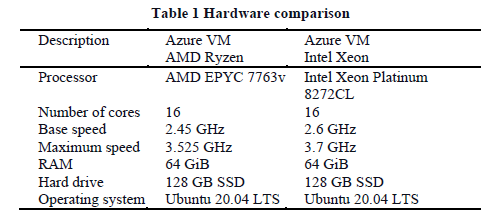
Processor Selection Criteria: Two virtual machines (VMs) were selected from AMD and Intel Xeon based on the number of cores, base speed, hard drive capacity, and operating system. Since a perfect match between the AMD and Intel Xeon models was not found, a close match was chosen instead.
Table 1 compares the AMD Ryzen and Intel Xeon specifications used in the study. The base frequency for Intel Xeon is higher by 6.12% than the AMD Ryzen. The maximum frequency for Intel Xeon is considerably higher. Still, we chose this machine expecting the processor to not use beyond the base frequency since the CFD simulation load is constant.
Methodology
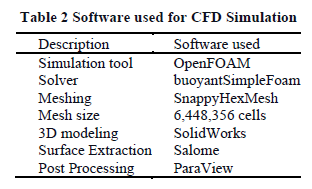
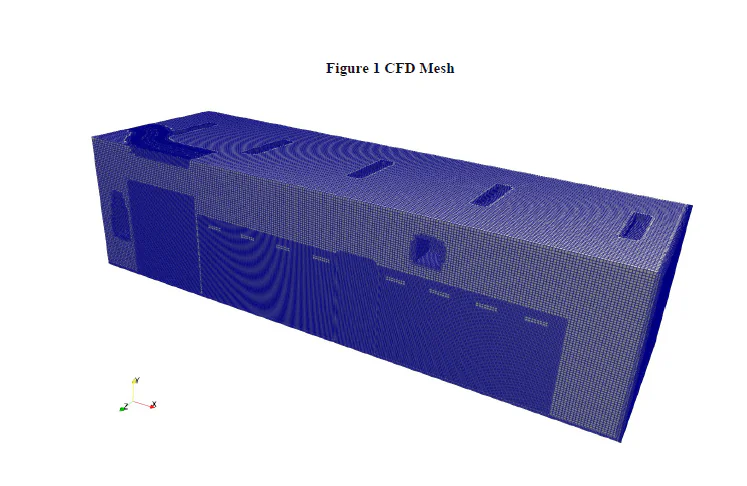
A test case setup with a mesh size of 6,448,356 has been prepared. The case setup, meshing, and all preprocessing were conducted on a local computer. The simulation was verified to run without errors, and the final results were confirmed as accurate. OpenFOAM was used to run the simulation, and MPI protocol was used for parallel processing to utilize all 16 cores in the CPU. Table 2 summarizes the details of the software used for setting up the CFD case, running the case, and mesh size. Figure 1 gives an overview of the hex-dominant mesh.
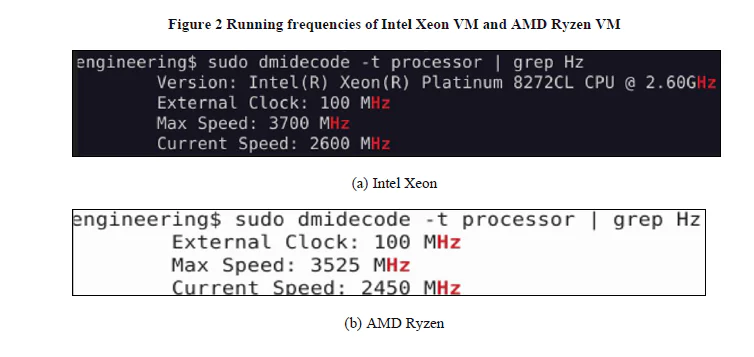
While the simulation was running, core usage from each CPU and running frequencies were monitored. Each VM utilized all 16 cores, and the running frequency for AMD was 2.45 GHz, and for Intel Xeon, it was 2.6 GHz. This demonstrates that the processor operates under a steady load without leveraging the potential of maximum frequency and allows us to compare performance better without considering the vast variations in the maximum frequencies between the hardware.
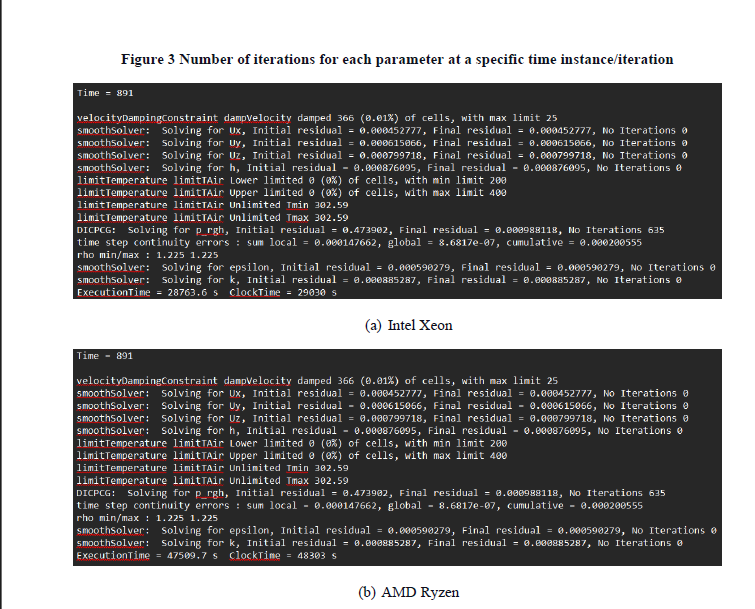
Also, the number of iterations for solving each functional parameter per time instance was monitored and found to be the same between the two machines to verify that there are no deviations in the case setup, mesh, and solving method between them. Figure 3 shows the number of iterations for each parameter solved in simulation and the time taken for an iteration/time instance. These details clearly show that the number of iterations for each time step is the same for each parameter on both machines.
Results and Analysis:
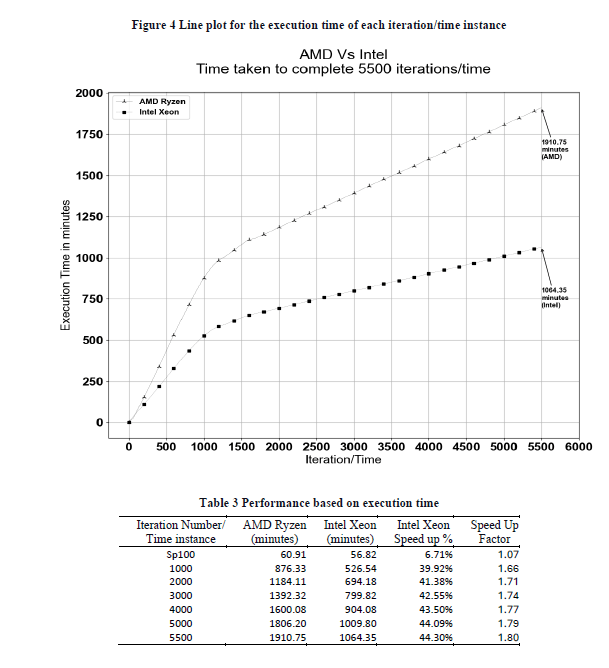
The simulation was run for 5,500 iterations, and the execution for each time instance was recorded and shown in Figure 4 using a line plot. And Table 3 lists the time taken to complete the specific number of iterations and speed up percentage (difference in time to complete it early) for Intel Xeon compared to AMD Ryzen.
Up to the first 100 iterations/time instances, both AMD and Intel Xeon took the same execution time, but slowly, Intel Xeon started performing well and taking less time to solve each time instance. The total time the Intel Xeon took to solve 5,500 iterations was 1064.35 minutes, which is 44.09% less time (1.79 times faster) compared to 1910.75 minutes taken by the AMD. Yes, the Intel Xeon processor speed is 2.6 GHz, which is 6.12% more compared to AMD’s base frequency of 2.45 GHz, but Intel Xeon outperformed and takes less computing time.
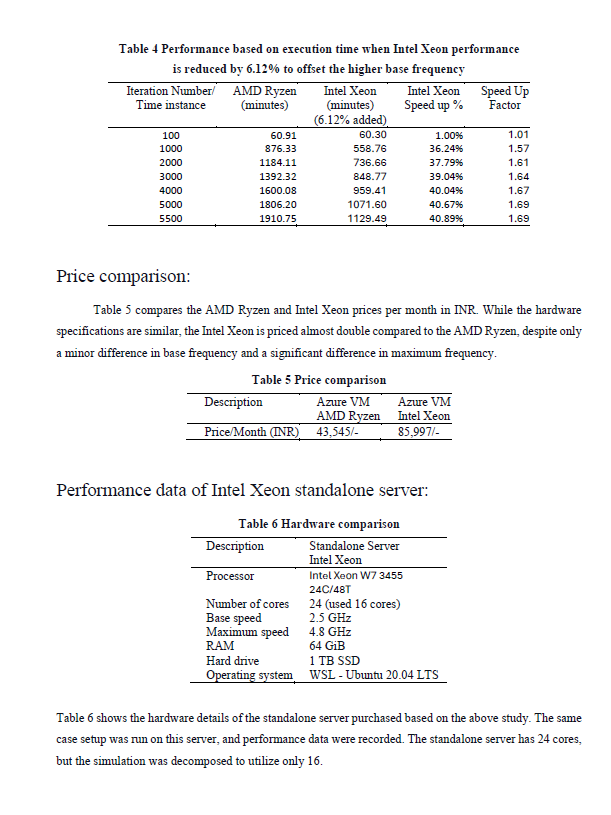
Since Intel Xeon’s base frequency is 6.12% higher than AMD Ryzen’s base frequency, comparison data is prepared after reducing Intel Xeon’s performance by 6.12%, as shown in Table 5. This data indicates that Intel Xeon performs better by 40.89% to complete 5500 iterations, which is 1.69 times faster than AMD Ryzen.
While the simulation was running, the current running frequency was monitored to ensure it used only the base frequency of 2.5 GHz and had no fluctuating loads. The simulation logs were also monitored for the number of iterations needed to solve the problem.
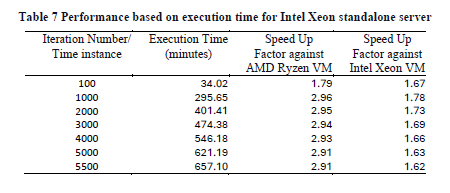
Table 7 shows the execution time for the standalone Intel Xeon machine and the speed-up factor compared to Intel Xeon VM and AMD Ryzen VM. The standalone CFD server’s base speed is 2.5 GHz, almost the same as both VMs, but it is 2.91 times faster than AMD Ryzen and 1.62 times more rapid than Intel Xeon in completing 5500 iterations.
Conclusion:
A CPU memory-based scientific simulation was run on two machines from different manufacturers, having the same number of cores, RAM, hard drives, and clock speeds (approximately), using OpenFOAM. It was found that Intel Xeon outperformed AMD for the specific models described in this study. Intel Xeon and AMD Ryzen processors excel in different applications, each offering strengths tailored to specific use cases. However, the Intel Xeon demonstrated superior performance in our tests, particularly excelling in the evaluated simulation workloads. When selecting a processor, it’s essential to consider its microarchitecture, instruction set, and optimization for specific tasks, in addition to factors like the number of cores, RAM, hard drive, and clock speeds. The cost of hardware is a significant factor to consider. We must invest more money if we want faster results with a specific hardware configuration. However, if we are mindful of costs, we can opt for less expensive hardware, which will delay obtaining the desired results.