
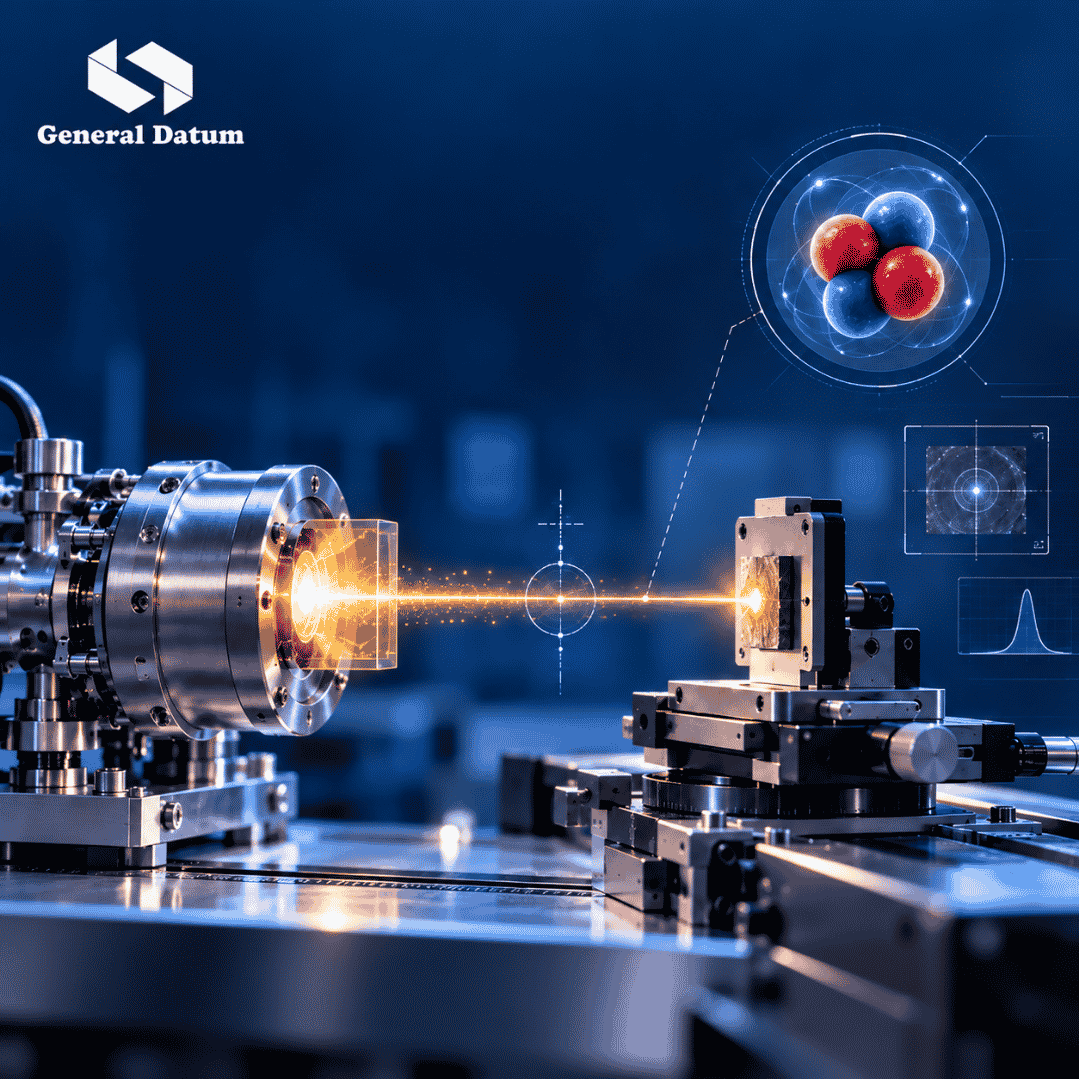
Having an alpha radiation source is important for research, but simply producing alpha radiation is not enough to conduct a reliable experiment.
The real challenge is control.
Alpha particles have a very short penetration range, but they deposit a significant amount of energy within that limited distance. Because of this, even small variations in the experimental setup can influence how much radiation reaches the sample and how the sample responds.
For meaningful research, irradiation conditions need to remain controlled and repeatable.
Researchers typically need to maintain:
• Uniform irradiation across the intended sample area
• Accurate exposure time for every experiment
• Repeatable sample positioning relative to the radiation source
• Consistent dose delivery between multiple experimental runs
• Reliable experimental data that can be compared and reproduced
These factors become especially important when researchers are studying biological samples, materials, electronic components, or other systems where small differences in radiation exposure may produce different outcomes.
Why Repeatability Matters
Scientific research depends heavily on repeatability.
If the same experiment is performed several times under the same conditions, researchers should be able to obtain comparable results.
However, in a manually controlled irradiation setup, small variations can easily occur.
A sample may be positioned slightly differently. Exposure time may vary by a few seconds. The distance between the radiation source and the sample may not remain exactly the same.
Individually, these differences may appear minor. But together, they can introduce uncertainty into the experiment.
When researchers are trying to understand subtle biological responses, material degradation, radiation effects on electronics, or other radiation-induced changes, controlling these variables becomes extremely important.
The Limitation of Manual Experimental Setups
Manual systems can be useful during early-stage experiments, but as research becomes more advanced, they can become a limitation.
Researchers may need to perform dozens or even hundreds of irradiation cycles while maintaining the same experimental conditions.
Repeating these processes manually increases the possibility of human variation and makes it more difficult to maintain consistency across large datasets.
This is where engineering becomes an important part of radiation research.
A properly engineered irradiation system can help control positioning, exposure duration, operating sequences, safety mechanisms, and experimental parameters more consistently.
Instead of relying entirely on manual intervention, researchers can focus more on the scientific outcome of the experiment.
From Radiation Source to Research System
Producing alpha radiation is therefore only one part of the challenge.
The next step is creating an environment where that radiation can be delivered in a controlled, repeatable, and measurable manner.
That requires the integration of radiation science with mechanical design, instrumentation, control systems, automation, and safety engineering.
As radiation research becomes more sophisticated, this level of control becomes increasingly important for generating dependable experimental results.
In the next part of this series, we will explore how automation can transform alpha irradiation experiments, helping researchers achieve greater consistency, repeatability, and control.