
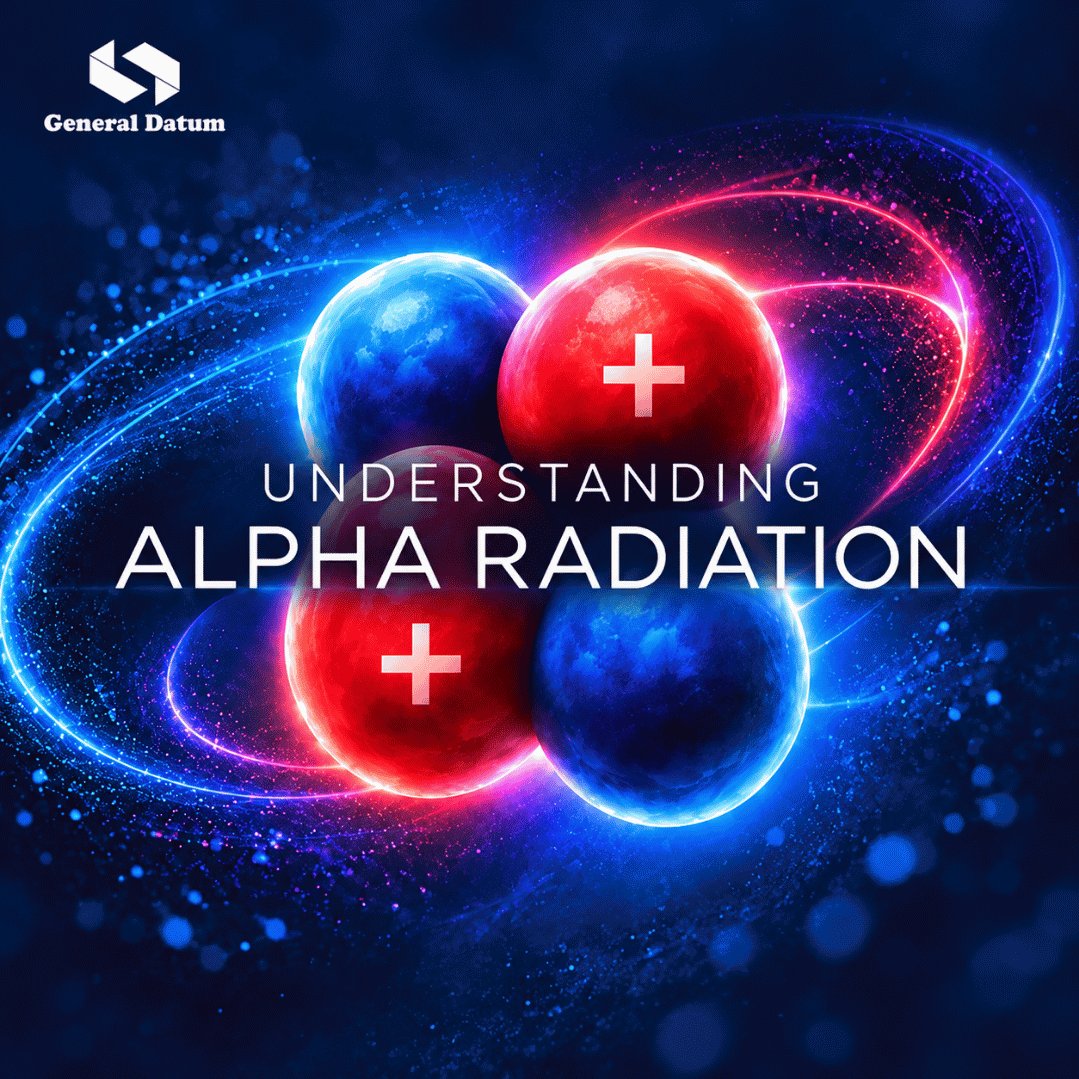
In the previous article, we learned that alpha particles are made up of two protons and two neutrons, making them relatively heavy compared to other types of radiation.
But there’s another property that makes them unique.
Scientists classify alpha particles as High LET (Linear Energy Transfer) radiation.
At first glance, that term sounds highly technical, but the idea behind it is surprisingly simple.
Linear Energy Transfer (LET) describes how much energy a particle deposits as it travels through a material.
Imagine two people running through a field.
One drops a single grain of sand every few steps.
The other drops handfuls of sand with every step.
Both travel the same distance, but one leaves behind far more material.
Alpha particles behave like the second person.
Instead of spreading their energy over a long distance, they release a large amount of energy within a very short path. Every millimeter they travel is packed with energy, creating dense interactions with the material around them.
This concentrated energy is what makes alpha particles extremely valuable in scientific research.
Researchers use them to investigate:
• How radiation damages DNA at the molecular level
• How cells respond to radiation exposure
• Radiation biology and its effects on living tissue
• The behavior of advanced materials under radiation
• The reliability of electronic components designed for harsh environments such as space, defense and nuclear applications
Interestingly, the same characteristic that limits alpha particles is also what makes them so useful.
Because they travel only a very short distance, scientists can expose a small, well-defined area without affecting everything around it. This level of control allows experiments that require precision rather than widespread exposure.
However, working with alpha radiation is not as simple as placing an alpha source on a laboratory bench.
To perform accurate and repeatable experiments, researchers need controlled exposure conditions, precise positioning, proper shielding, reliable safety systems, and specialized equipment that can deliver alpha particles exactly where they are needed.
And that raises an important question.
How do scientists generate precise, controlled alpha radiation for research without compromising safety?